
IWM
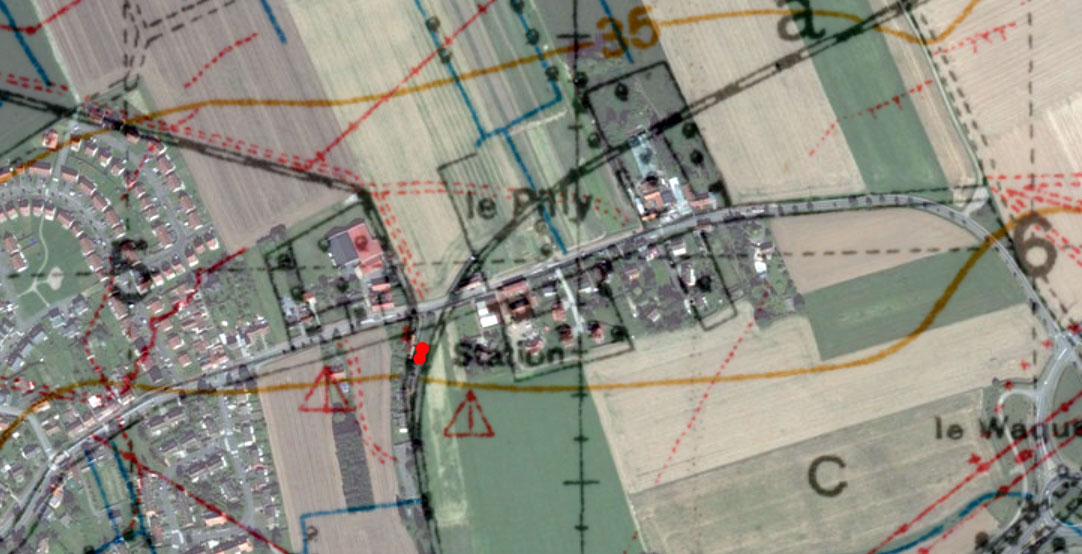
"On 19th October 1914 the 2nd Battalion received orders to attack Le Pilly conjointly with a French attack on Fournes. This latter attack did not take place, but the Royal Irish Regiment reached Le Pilly and drove the Germans out.
During the night the Irishmen dug themselves in where they were and reported that they were isolated, asking to be supported on both flanks. Reinforcements, however, were not available and on the following morning the battalion, which had already been decimated by the attack on the village, was attacked from opposite directions by the 16th German Regiment and a battalion of the 56th Regiment, supported by artillery. After a brave defence, which lasted until half-past three o'clock in the afternoon, the Irish were overcome and the survivors taken prisoners.
According to the report of an officer of the 56th Regiment, hardly one hundred of them could walk. On 19th October the effectives of the battalion were 20 officers and 884 other ranks. On the 21st only Lieutenant E.M. Phillips - the Transport officer - and 135 other ranks answered the roll call..." (This account of the 2nd Battalion's attack on Le Pilly was taken from a speech delivered by Lord Ypres on the occasion of the unveiling of the Royal Irish Regiment Memorial in Mons on 11th November 1923 and is to be found in "The Campaigns and History of the Royal Irish Regiment, volume 2" by Br. General Stannus Geoghegan, C.B.)
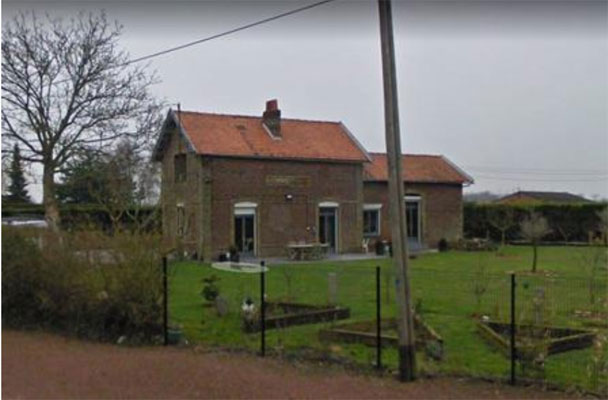
It seems that 170 men were killed and only the remains of eight have a grave. The others have no known resting place and are commemorated on two panels at the Le Touret memorial nearby. Lieutenant Jackson, an RAMC doctor attached to the battalion, was interviewed, after he was released, about what happened that day, and in the weeks and months that followed, as part of a general effort to gauge how well POWs were treated when held captive: "The Germans took me to a house and, wishing to search it, made me walk in front of them with two drawn bayonets behind me in case any of our men should be there and shoot. My great coat was taken from me...The Germans brought in about 30 wounded men (of the 2nd Battalion RIRgt): they brought them in very well; they then left in my charge for two days without any medical help..." Lieutenant Jackson was involved in helping to carry Lieutenant Harrison, and others, who had been badly wounded, to the station waiting room where the wounded were being gathered. "Not until our own doctor came back after dark with two Germans to carry me to a room at the railway station did I realise how helpless I was. By now I was too stiff to move at all. I then learnt of the awful tragedy that had befallen the battalion..."(M.C.C.Harrison from "Within Four Walls")
Lieutenant Jackson's account of what happened after the battle at Le Pilly is continued: "...they (the Germans) left them (the wounded) in my charge for two days without any medical help. A German doctor (speaking English well) came, shook hands with me and was friendly, but gave me no help. They only left some bully beef...and one loaf of black bread for my wounded men. One German orderly helped. One German N.C.O. was extremely kind; a young British subaltern had been killed, and this man brought me his identification disc, silver cigarette case, and a purse with seven sovereigns and some change. There was also a fountain pen which he asked to be allowed to keep. The place where we were at the time was under fire of the British guns. I sent to the doctor for help to get the wounded out of danger. He referred me to the general (a Saxon, name unknown): he promised to have my wounded taken back out of the firing line. I asked to be allowed to go and help; this was refused." In his book "Within Four Walls" Lieutenant Harrison also described the situation of the doctor and the wounded: "The plight of our wounded over these days was not an enviable one. We were left lying in the waiting-room at the station. Our own doctor was able to give us a certain amount of attention and get us food by collecting emergency rations from our dead. There was no German doctor available, so ours worked incessantly day and night for three days attending to the wounded of both sides...The evacuation of the wounded was completed on 23rd October..."